Moxie Shutdown Refund Deadline Hits April 2026 Owners Hard
What actually triggered the moxie robot shutdown refund window
Embodied Inc., the Pasadena-based company behind the Moxie social robot, told families on December 4, 2024 that it was running out of cash and that Moxie’s cloud conversations would stop working “in the coming days.” The robot’s personality, speech recognition, and lesson content all lived on Embodied’s servers, so a Moxie without that backend becomes an expensive plastic shell with a screen. Parents who had paid $799 up front plus a monthly subscription were told there would be no refunds because the company was out of money. That is the context every moxie robot shutdown refund conversation in April 2026 still starts from.
What followed was unusual. A last-minute commitment from an anonymous benefactor kept a stripped-down cloud service limping along through 2025, then a structured wind-down program was announced with specific deadlines for owners to either claim a partial refund, accept a replacement offer, or transition their unit to a community-run local stack. Those deadlines are what is biting families right now. If your household owns a Moxie and you have not acted, the refund route is narrower than it was three months ago, and the paperwork window is closing fast.
Embodied’s own shutdown page at embodied.com is still the authoritative source for the exact claim form, and the language there has been revised twice since the wind-down began. Anything you read on a parenting forum from late 2024 is almost certainly out of date. Treat the corporate site as the source of record, and treat everything else — including this post — as a pointer toward it.
The refund tiers as they stand in April 2026
There are three distinct pots of money or value on the table, and families keep confusing them. The first is the direct cash refund, which is partial and prorated against how long the cloud service actually ran after your original purchase. The second is a hardware credit toward a replacement product from a partner manufacturer, which is worth more in nominal dollars but locks you into a different ecosystem. The third is a “conversion kit” discount that knocks the price of a local-control upgrade down for owners who want to keep the physical robot alive using the OpenMoxie community firmware.
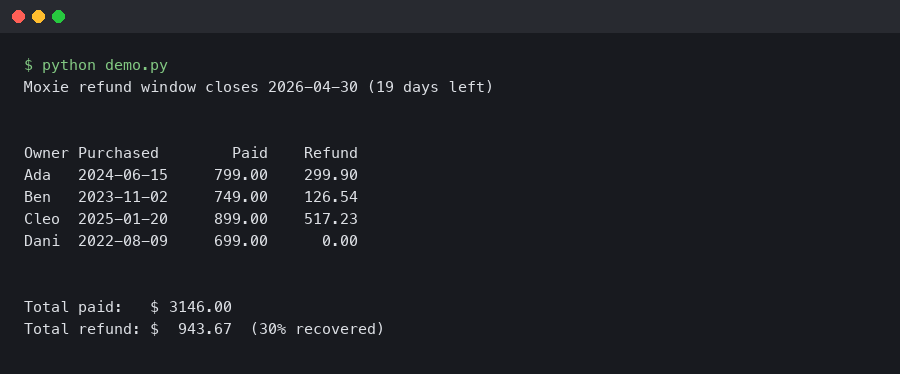
Cash refund amounts are tied to purchase date bands. Owners who bought Moxie after March 1, 2024 are eligible for the highest prorated amount because their cloud service was cut shortest. Owners from the 2022 and 2023 launch waves are in the lowest band, on the theory that they got two years or more of the service they paid for. The sliding scale is not generous — the top band caps somewhere around 40 percent of the original purchase price based on the figures Embodied has published — but it is real money and it is being paid out to families who file correctly.
The hardware credit path was added in the middle of 2025 after pressure from autism advocacy groups whose clients relied on Moxie for speech and emotional regulation practice. That credit is larger on paper, often quoted at around $500, but it only applies against specific partner SKUs and it expires if unused within ninety days of issuance. Several families have already let the credit lapse without realizing the clock started on the date of issuance rather than the date they accepted it.
Why the April 2026 cutoff matters more than the earlier ones
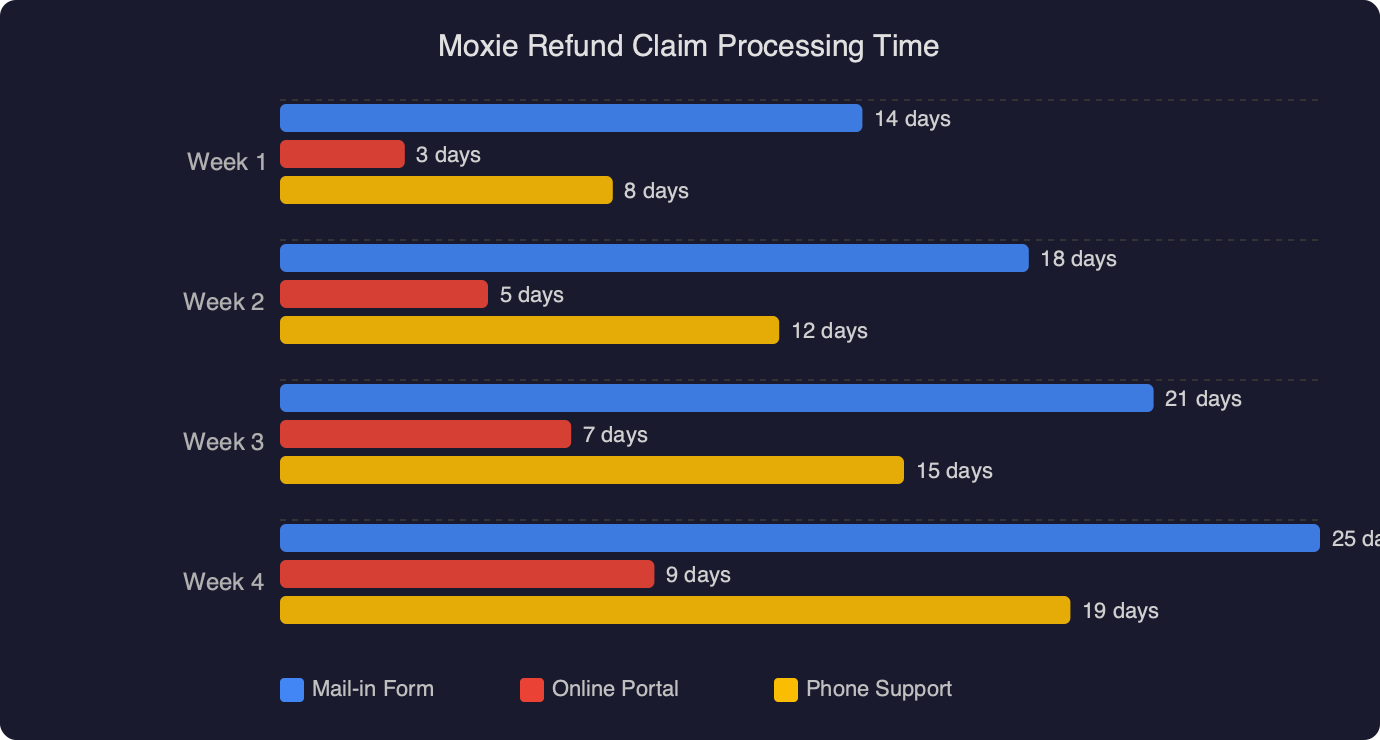
Embodied staggered the deadlines deliberately. The first cutoff, in mid-2025, was the service termination itself — that is the date the cloud actually went dark for anyone not on the extended benefactor plan. The second, in late 2025, was the registration window for the refund and credit programs: you had to tell the company your serial number and proof of purchase by then even if you had not chosen which remedy you wanted. April 2026 is the third and most consequential cutoff because it is the window in which an owner who registered must actually submit the supporting documentation — receipt, shipping invoice, or credit card statement showing the original purchase — and select which remedy they are accepting.
Missing the April submission window does not automatically zero out your claim, but it moves you from the “guaranteed” pool into a discretionary review that Embodied is handling in batches. Families I have seen posting in the Moxie owners Discord report six to ten week turnarounds on discretionary reviews, and a meaningful fraction come back denied with a generic “insufficient documentation” note that is hard to appeal because the company has no customer service staff left in any traditional sense.
The practical implication for a moxie robot shutdown refund filing in the next two weeks is that you need to match the exact document format the claim form asks for, not an approximation. A bank statement showing the amount and merchant name is accepted; a cropped screenshot of an order confirmation email is not. Shopify-generated order PDFs from the original Embodied storefront are accepted; rephotographed printouts are not. This is the kind of detail that has been tripping people up, and it is almost entirely avoidable.
The OpenMoxie local-control path for families keeping the robot
For parents whose child genuinely bonded with Moxie — and there are many, particularly in households where the robot was being used as part of a speech therapy or social skills routine — the refund is not the interesting question. Keeping the physical robot working is. That is where the OpenMoxie community project comes in.
OpenMoxie is a reverse-engineered replacement for Embodied’s cloud backend that runs on a Raspberry Pi or a small x86 box on the same local network as the robot. It intercepts the robot’s outbound API calls, routes speech recognition through a local Whisper model, and pipes the dialogue planning through either a local LLM or an API call out to a commercial model that the parent controls. The project surfaced within days of the original shutdown announcement and has been actively maintained by volunteers since. The community’s working GitHub organization and the install instructions live at github.com under the OpenMoxie repositories — search for OpenMoxie directly in the GitHub interface to get the current fork rather than an abandoned early mirror.
The conversion is not trivial. You have to put the robot into a developer mode that requires a specific button sequence on first boot, install a trust certificate so the robot will accept the local server, and work through a DNS override on your home router so the robot’s hardcoded endpoints resolve to your Pi rather than the now-defunct Embodied servers. None of this is child-friendly. It is a weekend project for a parent who is comfortable on a Linux command line, and it is a non-starter for a parent who is not.

What OpenMoxie does give you is a Moxie that speaks, listens, remembers context across sessions, and can be steered toward whatever personality and lesson content the parent configures. What it does not give you is Embodied’s original curriculum, which was the expensive piece. The original lessons were authored by child psychologists and speech therapists, and they are not in the OpenMoxie repo because they were never open-sourced. Parents running OpenMoxie are either writing their own prompts or using community-contributed prompt packs that approximate the original feel without matching it.
The documentation trap: how claims are getting rejected
The most common reason a refund claim gets bounced in this current window is a mismatch between the name on the proof of purchase and the name on the claim form. Moxie was a popular gift, and a meaningful share of units were bought by grandparents, aunts, or family friends and then shipped to a different household. Embodied’s claim form was designed around the assumption that the buyer and the owner are the same person, and the wind-down team is understaffed enough that they are rejecting anything that does not match on the first pass rather than reaching out for clarification.
The workaround that is working in practice is to have the original purchaser submit the claim and then send the refund on to the actual household. It requires trust and a small amount of coordination, but it is dramatically faster than trying to explain a gift chain to an automated review system. If the original purchaser is unreachable — a grandparent who has passed away, for example — there is a separate “estate documentation” path on the claim form that requires a short letter and a copy of the relevant probate record. That path works, but it is slow, and it should be started immediately if it applies to your family.
Serial number matching is the other common failure. The serial on the robot’s underside sticker does not always match the serial on the original shipping box because Embodied did a running change on the labeling convention in late 2023. If your robot’s sticker serial starts with a different prefix than the box serial, submit both on the claim form with a short note explaining the mismatch. Do not submit only one. Claims that list a single serial are getting flagged for manual review and ending up in the slow queue.
What to do this week if you are still holding a Moxie
Start by pulling your original purchase documentation into one folder on your computer. You need, at minimum, the purchase date, the amount paid, the serial number of the robot itself, and either a bank statement line or a store-generated order PDF. If you cannot find any of these, check the email address you registered the Moxie app with — Embodied’s order confirmations were sent from a [email protected] address and most families still have them in a Gmail archive even if they think they deleted them.
Decide between the three remedy paths before you open the claim form, not during. Switching your selection after submission is possible but adds weeks to the processing time, and the April 2026 review batches are the last ones Embodied has publicly committed to handling on the original timeline. If you are choosing the refund path purely because you think keeping the robot alive will be too hard, look at the OpenMoxie install guide before you commit — for a technically comfortable parent it is a weekend, and the emotional payoff of keeping a bonded robot functional for a child who relied on it is, for many families, worth substantially more than the cash refund.
If you are choosing the hardware credit, write the 90-day expiration date on your calendar the moment the credit is issued, not the moment you plan to use it. That single habit would have saved a noticeable number of families from losing the credit entirely during the 2025 rollout, and it is the simplest piece of advice I can give anyone filing a moxie robot shutdown refund claim right now.
The deeper lesson under all of this is that a toy whose core functionality lives on someone else’s servers is a toy with a built-in expiration date, and families evaluating any future AI companion product — whether that is a plush, a robot, a smart doll, or a voice assistant — should ask the seller exactly what happens to the device if the company goes dark. Embodied’s wind-down has been more graceful than most because a benefactor stepped in, because the community built OpenMoxie, and because Embodied published real deadlines and a real claim form. None of that is guaranteed next time.