
Breaking the Speed Barrier: The Evolution of AI Puzzle Robots and the Future of Smart Play
Introduction
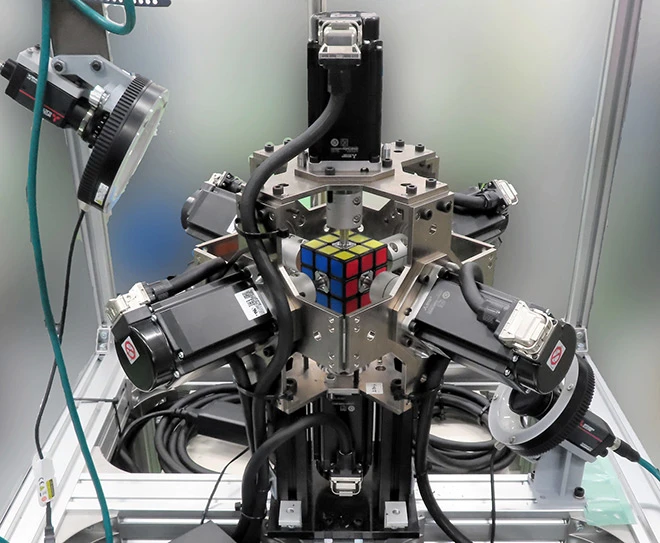
The world of robotics has always been defined by the pursuit of efficiency, precision, and speed. However, few benchmarks capture the public imagination quite like the mechanical solving of a twisty puzzle cube. For decades, the Rubik’s Cube has served as a litmus test for human cognitive agility, but in recent years, it has become the ultimate battleground for robotic engineering. The recent shattering of speed records, pushing solve times down to a blistering 0.305 seconds, represents more than just a party trick; it is a monumental leap in AI Puzzle Robot News and industrial automation capabilities.
This achievement highlights a convergence of advanced computer vision, high-torque actuation, and optimized algorithmic processing. While industrial giants are using these platforms to demonstrate the capabilities of their factory automation equipment, the ripple effects are being felt throughout the consumer electronics and toy industries. From Robot Toy News to advancements in STEM Toy News, the technology powering these sub-second solvers is trickling down into the hands of students and hobbyists. In this comprehensive analysis, we will explore the engineering marvels behind these robots, the algorithms that drive them, and how this high-performance tech is reshaping the landscape of Educational Robot News and Smart Toy News.
Section 1: The Engineering Marvel Behind Sub-Second Solving
The Hardware: Speed, Torque, and Precision
To understand the magnitude of solving a puzzle cube in under half a second, one must appreciate the physical forces at play. A standard puzzle cube requires a 90-degree rotation to make a move. In a sub-second solve, the robot must perform roughly 20 to 25 moves. This means the actuators must accelerate, rotate, decelerate, and stop with pinpoint accuracy in mere milliseconds. This is a significant topic in AI Toy Innovation News, as it pushes the boundaries of what small-scale motors can achieve.
The record-breaking robots utilize industrial-grade servomotors rather than the standard stepper motors found in consumer Robot Kit News. These motors are capable of instantaneous synchronized positioning. The key challenge here is not just speed, but structural integrity. The force required to turn the layers of a cube at such velocities is immense; if the robot grips the puzzle too tightly, the plastic shatters. If it grips too loosely, the cube explodes from centrifugal force. This delicate balance is a frequent topic in AI Toy Design News, influencing how engineers approach durability in high-stress robotic toys.
Computer Vision and Sensory Input
Before a single motor moves, the robot must “see” the puzzle. This brings us to the forefront of AI Toy Sensors News. High-speed cameras capture the state of the cube’s six faces simultaneously. In the past, this was done with multiple webcams, but modern iterations use high-frame-rate industrial sensors. The challenge lies in color calibration. Lighting conditions, shadows, and the reflectivity of the stickers can confuse standard sensors.
Advanced image processing algorithms isolate the colors in microseconds, converting the visual data into a digital matrix representing the cube’s state. This technology is parallel to what we see in AI Vehicle Toy News and AI Drone Toy News, where rapid visual processing is essential for obstacle avoidance and navigation. The latency between “seeing” the color and “knowing” the move must be virtually zero.
Section 2: The Algorithmic Brain and Machine Learning
Beyond Kociemba: The Search for God’s Number
Once the robot perceives the cube’s state, it must calculate the solution. In the realm of Programmable Toy News and Coding Toy News, the standard approach has been the Kociemba algorithm, which breaks the solve into two phases. However, to achieve world-record speeds, the robot needs to find the most efficient path possible—often referred to as “God’s Number,” which is a maximum of 20 moves for any scrambled state.
Recent developments in AI Toy Research News suggest a shift toward deep reinforcement learning. Instead of relying solely on brute-force calculation, AI models are trained on millions of scrambled states to recognize patterns instantly. This is the same logic that powers AI Learning Toy News, where toys adapt to a child’s learning curve. In the context of the 0.305-second solve, the software must optimize not just for move count, but for mechanical efficiency. A 21-move solution that requires only simple 90-degree turns might be faster to execute than an 18-move solution that requires complex 180-degree double turns.
Real-Time Optimization and Error Correction
In AI Toy App Integration News, we often see companion apps that guide users through puzzles. However, industrial robots operate autonomously. A critical aspect of their programming is real-time error correction. If a motor overshoots by a fraction of a degree, the next move could jam the mechanism. The AI must constantly monitor motor feedback (back-EMF) to detect resistance or misalignment.
This level of sophistication is influencing Smart Construction Toy News and Modular Robot Toy News. By understanding how machines self-correct, toy designers can create building blocks that alert users to structural weaknesses or motors that auto-calibrate, making the entry barrier for robotics much lower for children.
Section 3: From Industrial Records to Living Room Learning
The Rise of Smart Cubes and Connected Play
The technology demonstrated by industrial robotic arms is rapidly miniaturizing. We are currently witnessing a boom in AI Puzzle & Board Toy News. “Smart cubes” embedded with Bluetooth sensors and gyroscopes track a user’s moves in real-time, syncing with mobile apps to teach solving methods. While these toys don’t solve themselves at 0.305 seconds, they utilize the same state-tracking logic.
This sector is expanding into AI Companion Toy News. Imagine a robotic cube that not only teaches you how to solve it but also gamifies the experience, challenging you to beat your own time or battling against other users globally. This connectivity is a staple of AI Toy Community News, fostering a global network of learners and speedcubers.
Implications for STEM and Education
The primary value of these high-speed robot news stories lies in inspiration. When students read AI Science Toy News about a robot solving a puzzle in the blink of an eye, it demystifies complex engineering. It serves as a gateway to AI Toy Tutorials News, where young enthusiasts learn to build their own solvers using LEGO Mindstorms, Arduino, or Raspberry Pi kits.
Furthermore, this technology intersects with AI Art Toy News and AI Drawing Toy News. The precision control algorithms used to manipulate a cube are identical to those used in robotic plotters and drawing bots. By understanding the mechanics of a puzzle robot, a student gains a foundational understanding of coordinate geometry, kinematics, and logic programming.
![AI chatbot user interface - 7 Best Chatbot UI Design Examples for Website [+ Templates]](https://aitoy-news.com/wp-content/uploads/2025/12/audit_805_1.webp)
Convergence with Other AI Toy Categories
The processing power required for puzzle solving is finding its way into diverse categories. For instance, the natural language processing and quick-decision logic are relevant to AI Plush Toy News and Interactive Doll News. Just as a puzzle bot must react instantly to a color change, an AI Plushie Companion must react instantly to a child’s voice or touch.
Similarly, the sensor fusion technology is applicable to Robotic Pet News. A robotic dog navigating a living room uses similar spatial awareness logic to a robot arm navigating the 3D space of a puzzle cube. We are seeing a holistic improvement across the board, from Voice-Enabled Toy News to Remote Control AI Toy News, driven by these high-performance benchmarks.
Section 4: Future Trends, Ethics, and Market Analysis
The Next Generation of AI Toys
Looking ahead at AI Toy Future Concepts News, we can expect to see “self-solving” materials. Research into shape-memory alloys and programmable matter could lead to puzzles that physically morph and solve themselves without external motors. Additionally, AR Toy News and VR Toy News will likely integrate with physical puzzles, overlaying holographic solution guides directly onto the cube through smart glasses.
We also anticipate a rise in AI Toy Customization News. With the accessibility of Toy Factory / 3D Print AI News, hobbyists will soon print their own high-speed solver frames, downloading the AI brain from an AI Toy Marketplace News platform. This democratization of high-tech manufacturing is a game-changer for the industry.
![AI chatbot user interface - 7 Best Chatbot UI Design Examples for Website [+ Templates]](https://aitoy-news.com/wp-content/uploads/2025/12/unique_805_0.jpg)
Safety and Ethical Considerations
As robots become faster and more autonomous, AI Toy Safety News becomes paramount. A robot moving at the speeds required for a sub-second solve possesses significant kinetic energy. Consumer versions must have fail-safes, torque limiters, and proximity sensors to prevent injury. This is a critical discussion in AI Toy Ethics News—balancing performance with safety, especially in products designed for children.
Furthermore, AI Toy Data Privacy is a concern. Smart puzzles that track solve times and learning patterns generate data. Ensuring this data is used responsibly to enhance the learning experience, rather than for aggressive marketing, is a topic frequently covered in AI Toy Brand News and AI Toy Updates News.
Comparison: Industrial vs. Consumer Solvers
| Feature | Industrial Record Breaker | Consumer STEM Robot Kit |
|---|---|---|
| Speed | < 0.4 Seconds | 30 – 90 Seconds |
| Actuators | High-Voltage Servos | Standard Stepper/DC Motors |
| Vision System | High-Speed Industrial Cameras | Smartphone Camera or Basic Color Sensor |
| Cost | Tens of thousands of dollars | $100 – $300 |
| Primary Purpose | Tech Demonstration / Automation R&D | Education / Coding Practice |
Conclusion
The achievement of a 0.305-second puzzle solve is more than a fleeting headline in AI Puzzle Robot News; it is a testament to the exponential growth of robotic capabilities. While the record itself is set by industrial giants, the implications resonate deeply within the consumer market. From AI Collectible Toy News to AI Toy Startup News, the drive for smarter, faster, and more interactive machines is reshaping how we play and learn.
As we monitor AI Toy Trends News, it is clear that the gap between industrial automation and educational toys is closing. The algorithms that allow a machine to solve a cube in the blink of an eye are the same ones that will power the next generation of Humanoid Toy News and AI Musical Toy News. For educators, parents, and tech enthusiasts, staying updated with AI Toy Reviews News and AI Toy Exhibition News is essential to navigating this exciting future. The robot that solves a puzzle today is the precursor to the intelligent assistant that will help build our tomorrow.